For an unprepared visitor, a museum full of Asian art can be both impressive and strangely distant. The galleries are filled with exquisite statues, ceramics, ritual objects, textiles, and paintings. Everything looks refined. Everything feels important. And yet many first-time visitors leave with the same vague impression: they saw many beautiful artifacts, but they are not sure what any of it truly meant. At the Asian Art Museum in San Francisco, that gap between admiration and understanding is exactly where a guide can make the biggest difference. The museum itself emphasizes docent-led tours, storytellers, audio tours, and mobile guides as ways to deepen the visit, which already suggests that interpretation is central to the experience rather than secondary to it.
Asian art often asks more of the viewer than many people expect. A sculpture may not be “just” a sculpture. A seated figure may represent a deity, a historical teacher, a protective force, or a visual expression of philosophical ideas. A vessel may have been used in ritual rather than decoration. A painted hand gesture, a lotus base, a halo, or the number of arms on a figure can carry meaning that is invisible to someone without cultural or historical context. The Asian Art Museum holds a collection that spans thousands of years and many regions of Asia, and its galleries present works from major cultures across the continent. That scale is one of the museum’s strengths, but it can also overwhelm visitors who do not know where to begin.
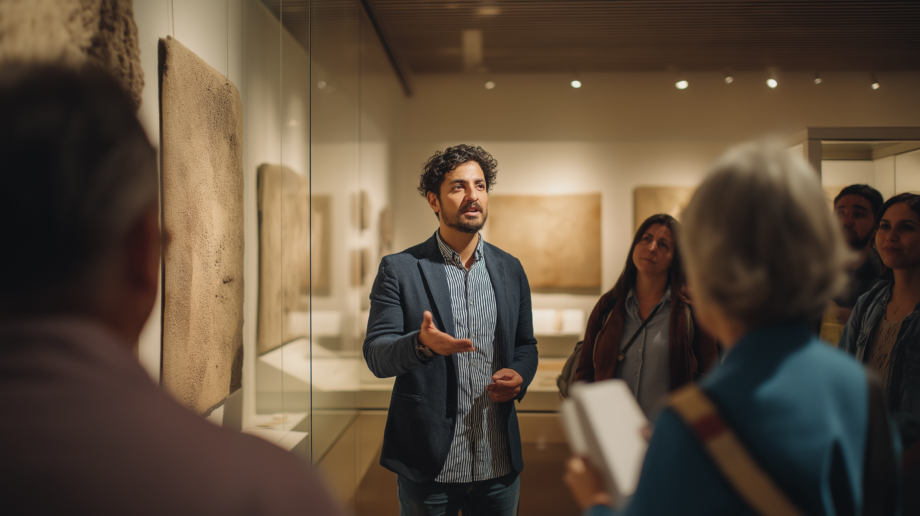
This is where a guide changes the visit from visual consumption into active understanding. A good museum guide does not simply provide facts. They build a structure for looking. Instead of letting the visitor drift from one object to the next, the guide introduces relationships: between religion and art, empire and craftsmanship, trade and symbolism, daily life and ritual practice. Suddenly a bronze figure is no longer only elegant metalwork. It becomes evidence of belief, political authority, artistic exchange, and human intention. A tour gives visitors not just more information, but a better way to pay attention.
One of the biggest benefits of a guided visit is that it slows people down in the right places. Many self-guided visitors move too quickly through museum spaces because they do not know which pieces deserve extra time. In a collection as broad as the Asian Art Museum’s, it is easy to treat the galleries like a sequence of attractive images. A guide interrupts that habit. They help visitors stop in front of a single object long enough to notice the details that transform it from decorative surface into historical testimony. Why is this Buddha smiling in one way and not another? Why is that guardian figure meant to look intimidating? Why does one ceramic bowl matter beyond its glaze? Once the right question is asked, the object begins to open.
Guides also help visitors overcome one of the most common barriers in museums: uncertainty. Many people are hesitant to engage deeply with art from traditions they did not study in school. They worry about misunderstanding symbols, mispronouncing names, or asking “simple” questions. In a guided setting, that fear weakens. The visitor is invited into interpretation instead of being left alone with it. What might feel intimidating on the wall label becomes approachable in conversation. A guide gives permission to be curious.
At the Asian Art Museum, that role is especially valuable because the collection spans cultures, faiths, and time periods that may be unfamiliar to a broad American audience. The museum describes itself as home to a world-renowned collection of more than 18,000 objects spanning 6,000 years, with over 2,000 works on view in the galleries and tours available daily through knowledgeable docents. In practice, that means no visitor is likely to arrive already equipped to understand everything they are seeing. A guided experience is not a luxury add-on. For many people, it is the difference between partial recognition and genuine encounter.
A guide also gives emotional shape to the museum visit. Without interpretation, galleries can flatten into repetition: another statue, another vessel, another painted screen. With interpretation, variation appears. The guide can show how one object was meant for devotion, another for display, another for burial, and another for use in daily life. They can trace how styles traveled across borders, how religious images changed over centuries, or how one region’s craftsmanship influenced another’s. What first appears as a room of similar objects becomes a story of movement, adaptation, and human imagination.
This narrative function matters because museums are not simply storage spaces for rare things. They are places where objects are asked to communicate across time. Ancient artifacts do not speak modern language on their own. They require mediation. Labels help, of course, and the Asian Art Museum also offers mobile and audio guides that support self-paced exploration. But a human guide adds something technology cannot fully replace: responsiveness. The guide can read the room, notice confusion, answer questions immediately, and shift emphasis depending on what the group finds compelling. The tour becomes less like reading captions and more like entering a conversation.
There is also an important difference between being told what an artifact is and being shown why it mattered. A label may identify a sculpture as originating in a particular dynasty or region. A guide can go further and connect that object to ritual practice, social hierarchy, pilgrimage, trade, craftsmanship, or ideas of the sacred body. In other words, the guide restores function, context, and consequence. The object regains some of the life it had before entering a museum case.
For visitors who think they are “not museum people,” this can be transformative. The problem is often not the museum itself, but the lack of an interpretive bridge. Many people do not need simpler art. They need better entry points. A skilled guide provides those entry points through story, comparison, and emphasis. They can relate a thousand-year-old object to universal themes such as grief, power, beauty, protection, memory, and devotion. Once that happens, the distance between past and present narrows.
That is why the Asian Art Museum can feel completely different with a guide. Without context, a visitor may remember only polished surfaces and elegant forms. With a guide, the same galleries become a map of civilizations, beliefs, trade routes, artistic decisions, and human values. The artifacts do not stop being beautiful. They simply become more than beautiful. And that is often the moment when a museum visit changes from passive looking into real discovery.

Author: Benjamin